
The South American Plate: Foundation of a Continent
The South American Plate underpins most of South America and a large part of the South Atlantic seafloor. As the fourth-largest tectonic plate, it drives significant geological features, including the world's longest mountain range and the planet's biggest oceanic ridge system.
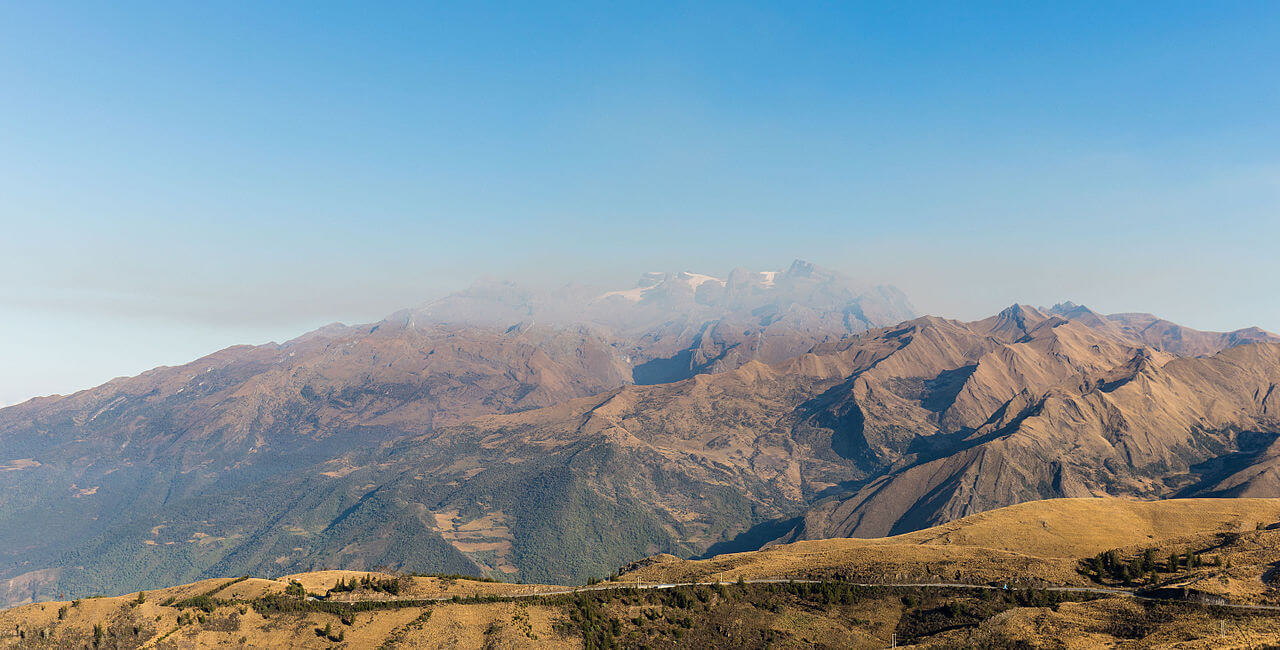
Tectonic Foundation: How the South American Plate Shapes a Continent
The South American Plate forms the geological foundation beneath most of South America and a significant portion of the South Atlantic Ocean seafloor. Despite being the fourth-largest tectonic plate at approximately 43.6 million square kilometers (16.8 million square miles), this continental plate plays a central role in some of Earth's most dramatic geological processes, from the world's longest mountain range to the planet's most extensive oceanic ridge system.
Plate Structure and Composition
The South American Plate consists of both continental and oceanic crust, with the continental portion underlying virtually all of South America except for small northern areas occupied by the Caribbean Plate. The oceanic portion extends eastward beneath the South Atlantic, reaching halfway to Africa. This dual nature makes it unique among the world's major tectonic plates and directly influences the geological diversity found across the continent.
The continental crust varies significantly in thickness, reaching up to 70 kilometers (43 miles) beneath the highest Andes peaks while thinning to approximately 35 kilometers (22 miles) under the Brazilian Highlands. The oceanic portion averages 6-8 kilometers (4-5 miles) in thickness, typical of oceanic crust worldwide.
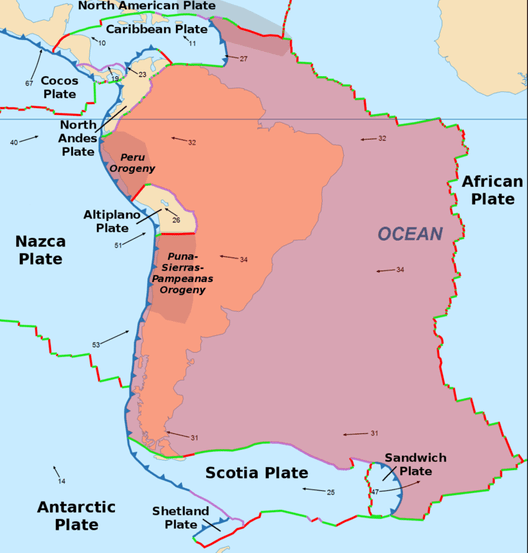
Map depicting the South American plate boundaries.
Eastern Boundary: The Mid-Atlantic Ridge
The plate's eastern boundary forms the southern segment of the Mid-Atlantic Ridge, Earth's longest mountain range extending over 65,000 kilometers (40,000 miles). Here, the South American and African plates diverge at a rate of approximately 3 centimeters (1.2 inches) per year, creating new oceanic crust through volcanic activity along the ridge axis.
This spreading process began roughly 130 million years ago during the breakup of the supercontinent Gondwana. The ridge system includes several notable features: the Ascension Fracture Zone, the St. Helena Fracture Zone, and the Rio Grande Rise, an aseismic ridge that represents the track of the Tristan da Cunha hotspot.
Western Boundary: The Peru-Chile Trench and Andean Orogeny
The western margin represents one of Earth's most active convergent boundaries, where the oceanic Nazca Plate subducts beneath the South American continental margin. This process occurs along the Peru-Chile Trench, which extends over 5,900 kilometers (3,700 miles) from northern Peru to southern Chile, reaching maximum depths of 8,065 meters (26,460 feet) near northern Chile.
Subduction rates vary along this margin, ranging from 59 millimeters (2.3 inches) per year in northern Peru to 90 millimeters (3.5 inches) per year in northern Chile. This rapid convergence drives the ongoing formation of the Andes Mountains, which contain over 200 potentially active volcanoes and represent the world's longest continental mountain range, spanning approximately 8,900 kilometers (5,530 miles).
The subduction process also generates frequent seismic activity. Chile experiences some of the world's most powerful earthquakes, including the 1960 Valdivia earthquake (magnitude 9.5), the strongest earthquake ever recorded. These events result from the sudden release of stress accumulated as the Nazca Plate descends into the mantle.
Northern Boundary: Caribbean Complexity
The northern boundary presents complex interactions with the Caribbean Plate along the northern coasts of Venezuela, Guyana, Suriname, and French Guiana. This boundary zone encompasses both transform faulting and limited subduction, resulting in a tectonically active region that experiences regular seismic activity.
The boundary extends offshore to encompass the Lesser Antilles subduction zone, where South American oceanic crust subducts westward beneath the Caribbean Plate. This process created the volcanic arc of the Lesser Antilles, including active volcanoes such as Mount Pelée in Martinique and Soufrière Hills in Montserrat.
Southern Boundary: Antarctic Connections
The southern boundary interacts with the Antarctic Plate through the Scotia Plate, creating a complex triple junction system. The South American Plate also interfaces with the small Scotia Plate along the Drake Passage, south of Cape Horn. Transform faulting dominates these interactions, with the Shackleton Fracture Zone marking the primary boundary between the South American and Antarctic plates.
Geological Significance and Resources
The South American Plate's diverse geological history has created extraordinary mineral wealth. The Andes contain major copper deposits in Chile and Peru, significant gold deposits throughout the range, and the world's largest lithium reserves in the Atacama Desert. The stable continental interior hosts important iron ore deposits in Brazil's Iron Quadrangle and vast petroleum reserves in Venezuela's Orinoco Basin.
The plate's geological processes also created unique ecosystems. The rapid uplift of the Andes influenced continental climate patterns, creating the Amazon Basin's humid environment while simultaneously forming the Atacama Desert, one of Earth's driest regions. These contrasting environments support extraordinary biodiversity, including endemic species such as the Cinclodes aricomae (royal cinclodes) found only in high Andean wetlands.
Future Evolution
Current plate motions indicate a continued westward movement of 27-34 millimeters (1.1-1.3 inches) per year, which is expected to sustain ongoing Andean volcanism and seismic activity. The Atlantic Ocean continues to widen as South America moves away from Africa, while the Pacific margin experiences ongoing compression and mountain building.
Understanding the South American Plate provides crucial insights into continental geology, mountain-building processes, and the relationship between tectonics and biodiversity. Its role in global plate tectonics demonstrates how major geological processes shape both physical landscapes and biological evolution over geological time scales.
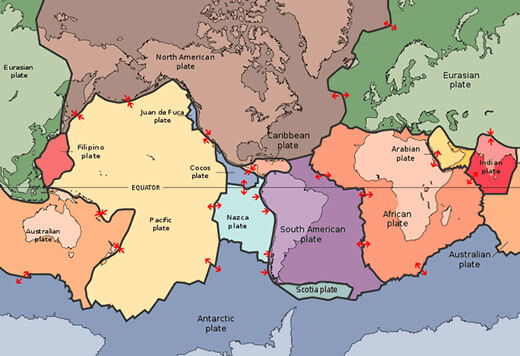
Map depicting the major tectonic plates of the world.