
The Scotia and South Sandwich Plates: Southern Ocean Tectonic Complexity
The Scotia and South Sandwich plates are small tectonic plates forming a key geological link between Antarctica and South America. They show how minor plates can create major features, like remote volcanic arcs and deep trenches, connecting the southern Andes to the Antarctic Peninsula.
Southern Ocean Tectonics: Complex Plate Interactions in the Scotia Arc
The Scotia and South Sandwich plates represent a complex system of small tectonic plates that create a critical geological bridge between Antarctica and South America. Together, these plates demonstrate how minor tectonic entities can generate significant geological features, from the world's most remote volcanic arc to one of the deepest oceanic trenches, while facilitating the connection between the southernmost Andes and the Antarctic Peninsula.
The Scotia Plate: Gateway Between Continents
The Scotia Plate covers approximately 1.6 million square kilometers (0.62 million square miles) beneath the Scotia Sea, positioned between the South Atlantic Ocean and Southern Ocean. This predominantly oceanic plate serves as a crucial link in the tectonic chain connecting South America's southernmost Andes to the Antarctic Peninsula, much as the Caribbean Plate connects North America to northern South America.
The plate exhibits a roughly triangular shape, measuring approximately 800 kilometers (497 miles) in width and 3,000 kilometers (1,864 miles) in length. Its motion is primarily westward-southwest at approximately 22 millimeters (0.87 inches) per year, accommodating the relative motion between the much larger South American and Antarctic plates.
Geological Structure and Evolution
The Scotia Plate formed through complex processes involving back-arc spreading and the progressive eastward migration of subduction systems during the past 30 million years. This evolution created the Scotia Arc, a curved chain of islands and submarine ridges that extends from Tierra del Fuego to the South Sandwich Islands.
The plate consists primarily of oceanic crust with ages ranging from approximately 30 million years in the west to near-zero at active spreading centers. However, several portions contain uplifted oceanic crust and continental fragments, creating the emerged land areas of South Georgia Island and other scattered islets.
The Scotia Arc represents one of Earth's most complex tectonic systems, involving multiple episodes of subduction zone migration, back-arc spreading, and microplate formation. This complexity resulted from the challenging geometric requirements of connecting the east-west trending southern Andes with the north-south trending Antarctic Peninsula.
Scotia Plate Boundaries
The Scotia Plate interacts with four neighboring plates through diverse boundary types that accommodate its complex motion. The northern boundary with the South American Plate consists primarily of transform faulting along the North Scotia Ridge, extending from Tierra del Fuego eastward to the South Sandwich Islands region.
The South Scotia Ridge forms the southern boundary with the Antarctic Plate, also characterized by predominantly transform motion. However, this boundary exhibits more complex geometry with several bends and offsets that create local zones of convergence and extension.
The western boundary involves complex interactions with both the South American and Antarctic plates near the Drake Passage. This region represents one of the most tectonically complex areas on Earth, where multiple plate boundaries converge in a small geographic area.
The eastern boundary transitions into the South Sandwich subduction zone, where the relationship with the South Sandwich Plate becomes increasingly important for understanding regional tectonics.
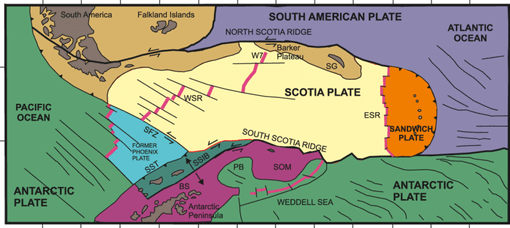
Map depicting the tectonic setting of the Scotia Plate and South Sandwich Plate.
The South Sandwich Plate: A Volcanic Arc System
The South Sandwich Plate, though much smaller than the Scotia Plate at approximately 0.3 million square kilometers (0.12 million square miles), hosts one of the world's most active and remote volcanic arc systems. This narrow, curved plate extends approximately 500 kilometers (311 miles) along the South Sandwich Islands volcanic arc.
The plate formed through back-arc spreading processes that began approximately 8 million years ago, creating the East Scotia Ridge spreading center that separates it from the Scotia Plate. This spreading occurs at rates of approximately 65 millimeters (2.6 inches) per year, among the fastest back-arc spreading rates globally.
The South Sandwich Islands volcanic arc contains 11 major volcanic islands and numerous submarine volcanic centers, representing one of the most volcanically active regions in the Southern Hemisphere. Recent volcanic activity includes major eruptions at Mount Michael on Saunders Island and ongoing activity at several other centers.
Subduction Zone Dynamics and the South Sandwich Trench
The eastern margin of the South Sandwich Plate hosts the South Sandwich subduction zone, where South American oceanic crust descends westward beneath the volcanic arc. This subduction zone extends approximately 520 kilometers (323 miles) from north to south and accommodates convergence rates of 67-79 millimeters (2.6-3.1 inches) per year.
The South Sandwich Trench (also known as the Scotia Trench) represents one of the deepest features in the Atlantic Ocean, reaching maximum depths of 8,428 meters (27,651 feet). This trench extends approximately 965 kilometers (600 miles) in a north-south direction, parallel to the South Sandwich Islands volcanic arc, making it a significant topographic feature of the Southern Ocean.
The formation of the trench through the rapid subduction of young, warm oceanic lithosphere creates distinctive characteristics compared to other global subduction systems. The steep subduction geometry, combined with the relatively young age of the subducting South American oceanic crust (created at the nearby Mid-Atlantic Ridge within the past 40 million years), generates intense volcanic activity and creates the deep oceanic trench that defines the region's seafloor topography.
East Scotia Ridge: Back-Arc Spreading
The East Scotia Ridge represents one of the world's most active back-arc spreading systems, separating the Scotia and South Sandwich plates through seafloor spreading processes. This ridge system demonstrates how subduction zones can generate extension and new oceanic crust behind volcanic arcs.
Spreading along the East Scotia Ridge occurs at rates comparable to mid-ocean ridges, creating new oceanic crust through volcanic activity at the ridge axis. However, the ridge exhibits distinctive characteristics related to its back-arc setting, including different magma compositions and hydrothermal activity patterns compared to normal mid-ocean ridges.
The ridge system includes several transform fault offsets that accommodate spreading direction changes along its length. These offsets create complex three-dimensional geometries that influence local tectonics and volcanic activity patterns.
Volcanic Activity and Hazards
The South Sandwich Islands volcanic arc represents one of the most active volcanic systems in the Southern Hemisphere, with frequent eruptions documented through satellite observations despite the region's extreme remoteness. The arc contains both subaerial and submarine volcanic centers, with several islands experiencing recent major eruptions.
Mount Belinda on Montagu Island underwent a major eruption beginning in 2001 that continued for several years, creating new land area and demonstrating the ongoing volcanic construction of the arc. Similar activity occurs throughout the chain, with satellite thermal anomalies indicating frequent volcanic unrest.
The extreme isolation of these volcanoes means that most eruptions go unobserved except through remote sensing techniques. However, their potential for generating volcanic ash clouds poses risks to aircraft routes between South America and southern Africa.
Seismic Activity and Earthquake Patterns
The Scotia Plate system generates frequent seismic activity through its complex boundary interactions and internal deformation. Transform faulting along the North and South Scotia Ridges produces regular moderate earthquakes, while the South Sandwich subduction zone generates both shallow thrust events and deeper intraslab earthquakes.
The 2003 Scotia Sea earthquake (M 7.6) demonstrated the potential for large seismic events within this system. This earthquake occurred along the South Scotia Ridge and was felt across much of the southern Atlantic region, highlighting the significant seismic energy release possible in this remote area.
Earthquake depths within the South Sandwich subduction zone extend to approximately 200 kilometers (124 miles), indicating active subduction of oceanic lithosphere into the upper mantle. The steep subduction angle creates a compact Wadati-Benioff zone that provides clear evidence for ongoing subduction processes.
Biological and Ecological Significance
Despite extreme environmental conditions, the Scotia Plate region supports unique marine ecosystems adapted to the Southern Ocean's harsh conditions. The South Georgia Island ecosystem, situated on the Scotia Plate, represents one of the world's most important breeding grounds for Antarctic wildlife.
Endemic species such as the Poa flabellata (tussock grass) create distinctive coastal ecosystems on South Georgia and other Scotia Arc islands. These ecosystems support massive populations of seals, penguins, and seabirds that depend on the productive marine environments created by complex ocean circulation patterns influenced by Scotia Plate topography.
The South Sandwich Islands host unique biological communities adapted to active volcanic environments in polar conditions. Species such as Colobanthus quitensis (Antarctic pearlwort) demonstrate remarkable adaptation to the combination of volcanic disturbance and extreme cold that characterizes these remote islands.
Ocean Circulation and Climate Connections
The Scotia Plate system plays a crucial role in Southern Ocean circulation by creating topographic barriers and channels that influence the Antarctic Circumpolar Current. The Drake Passage, bounded by Scotia Plate structures, represents the narrowest constriction for this massive current system.
The complex topography created by Scotia Arc tectonics generates upwelling and mixing processes that enhance biological productivity throughout the region. These processes support the extensive marine ecosystems that depend on the Southern Ocean's nutrient-rich waters.
Geological processes within the Scotia system influence ice sheet dynamics through their effects on ocean circulation and heat transport. Changes in Scotia Plate tectonics over geological time scales may have influenced Antarctic ice sheet stability and global climate patterns.
Research Challenges and Scientific Significance
The extreme remoteness and harsh conditions of the Scotia Plate region create significant challenges for geological research. Most studies rely on marine geophysical surveys, satellite observations, and occasional research expeditions during brief Antarctic summer seasons.
Recent advances in remote sensing and autonomous instrumentation have revolutionized understanding of Scotia Plate processes. Satellite interferometry reveals ongoing volcanic activity, while ocean bottom seismometers provide detailed earthquake monitoring in previously inaccessible areas.
The Scotia system provides crucial insights into how complex plate boundary systems evolve and maintain stability over geological time scales. Understanding these processes has broader implications for global tectonics and the behavior of other complex plate boundary zones worldwide.
Future Evolution and Global Implications
Current Scotia Plate motions suggest continuing westward migration and potential future changes in the configuration of Southern Ocean plate boundaries. The ongoing back-arc spreading at the East Scotia Ridge may eventually create new plate boundary geometries as the system continues evolving.
Changes in Scotia Plate tectonics could significantly influence Southern Ocean circulation patterns and Antarctic ice sheet dynamics. Understanding these potential changes becomes increasingly important as global climate change accelerates modifications to polar regions.
The Scotia and South Sandwich plates demonstrate how small tectonic entities can create disproportionately significant geological and environmental impacts through their strategic positions in global systems. Their continuing evolution affects Southern Ocean circulation, Antarctic ice sheet dynamics, and global climate patterns, making them crucial components of the Earth system despite their modest size.
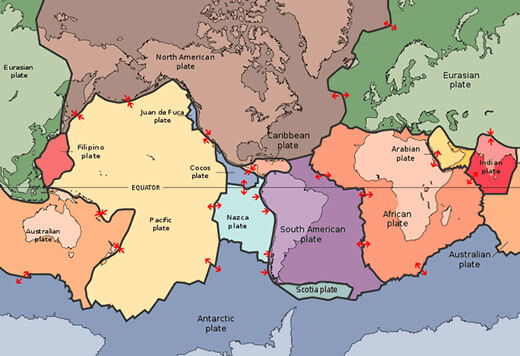
Map depicting the major tectonic plates of the world.