
Bridging the Americas: The Great American Biotic Interchange
For millions of years, North and South America remained isolated, each evolving unique species due to different environmental pressures. About 3 million years ago, the formation of the Central American Isthmus created a land bridge, leading to the Great American Biotic Interchange (GABI).
The Great American Biotic Interchange: When Two Continents Collided
For millions of years, North and South America existed as isolated landmasses, separated by a vast oceanic expanse. Each continent evolved its own unique assemblage of species, shaped by distinct environmental pressures and evolutionary pathways. However, approximately 3 million years ago, a transformative geological event changed the course of biological history across both continents: the formation of the Central American Isthmus created a permanent land bridge, triggering one of the most spectacular mass migrations in Earth's history.
The Great American Biotic Interchange (GABI) represents a pivotal chapter in evolutionary biology, demonstrating the profound impact that geographical barriers—and their removal—can have on biodiversity, ecosystem structure, and species distribution. This unprecedented biological exchange transformed the ecological landscapes of both the North and South American continents, resulting in extinction events, adaptive radiations, and the creation of the diverse faunal assemblages we observe in the Americas today.
The Geological Stage: Formation of the Isthmus
The story of the Great American Biotic Interchange begins with plate tectonics and the gradual rise of a land bridge between two continental masses. Throughout much of the Cenozoic Era, North and South America remained separated by the Bolivar Trough, a marine channel that served as an effective barrier to terrestrial species dispersal.
The formation of the Central American Isthmus resulted from the complex interaction between the Caribbean Plate, the Cocos Plate, the South American Plate, and the North American Plate. As these tectonic plates converged, volcanic activity and crustal uplift gradually created an archipelago of islands that would eventually coalesce into a continuous land bridge.
Between approximately 15 and 3 million years ago, the isthmian region experienced periods of volcanic activity, mountain building, and sediment deposition. By approximately 3.5 to 3 million years ago, during the Pliocene Epoch, the land bridge achieved sufficient continuity to permit substantial terrestrial migration.
The completed isthmus, stretching approximately 518,000 square kilometers (200,000 square miles), created more than just a physical connection. It established a corridor through which species could migrate, compete, and evolve. The narrow strip of land, ranging from as little as 50 kilometers (31 miles) wide at its narrowest point in Panama, became one of the most biodiverse regions on Earth, serving as both a meeting ground and a battleground for species from vastly different evolutionary lineages.
Before the Bridge: Isolated Continents
To appreciate the magnitude of the Great American Biotic Interchange, one must understand the striking differences between North and South American fauna prior to the connection.
South America: An Island Continent
For approximately 60 million years following the breakup of Gondwana, South America functioned as an isolated island continent. This extended period of isolation fostered the evolution of a bizarre and unique fauna that had few counterparts elsewhere on Earth.
Several distinctive groups dominated South America's mammalian fauna. Marsupials flourished in various ecological niches, including large predatory species such as Thylacosmilus, a saber-toothed marsupial that convergently evolved features similar to those of placental saber-toothed cats.
The continent was also home to xenarthrans, a group that includes modern sloths, anteaters, and armadillos. During the Cenozoic, this group produced remarkable forms, including ground sloths that could reach the size of elephants and glyptodonts—armored mammals resembling massive armadillos, some species exceeding 3 meters (10 feet) in length and weighing more than 2,000 kilograms (4,400 pounds).
Perhaps most peculiar were the South American ungulates, a diverse assemblage of herbivorous mammals that evolved independently of those on other continents. These included Macrauchenia, a long-necked, camel-like creature with a trunk-like proboscis.
South America's isolation also allowed for the evolution of terror birds (Phorusrhacidae), flightless predatory birds that stood up to 3 meters (10 feet) tall and served as dominant carnivores in certain ecosystems. These formidable hunters possessed massive hooked beaks and powerful legs, filling ecological roles occupied by large mammalian predators on other continents.
North America: Connected to the World
In contrast to South America's isolation, North America maintained periodic connections with Eurasia via the Bering land bridge, facilitating faunal exchanges between North America and the Old World throughout much of the Cenozoic.
North American fauna included familiar groups such as canids (dogs and their relatives), felids (cats), bears, horses, camels, deer, and proboscideans (elephants and mastodons). These placental mammals had evolved competitive strategies honed through interaction with diverse predators and competitors across two continents.
The carnivore guilds of North America were particularly sophisticated, including true cats and dogs. Herbivore communities were equally diverse, with horses, camels, and peccaries occupying a range of grazing and browsing niches. This greater connectivity to global faunal systems provided North American mammals with evolutionary experiences that would prove advantageous when the two continents finally connected.
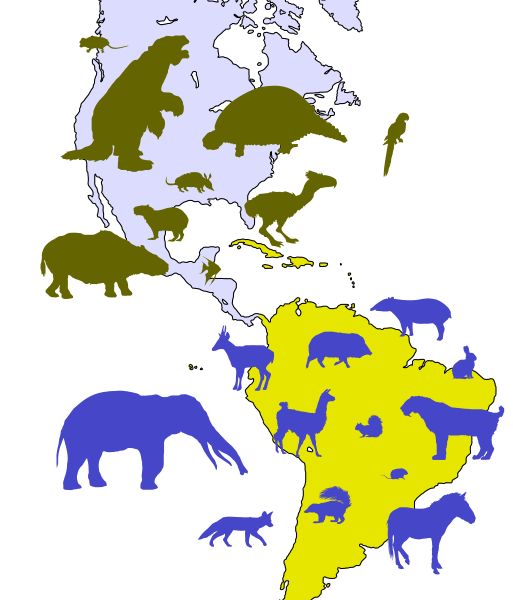
Examples of new species of the Great American Biotic Interchange, an event caused by the tectonic creation of the Isthmus of Panama in the late Pliocene. South American (neotropic) species whose ancestors migrated to North America are in (olive) green, North American (nearctic) species whose ancestors migrated to South America are in blue.
The Great Exchange: Migration Patterns
When the land bridge finally achieved permanence, species from both continents began their journeys across the narrow isthmus. However, the exchange was neither instantaneous nor symmetrical.
The Northern Invasion
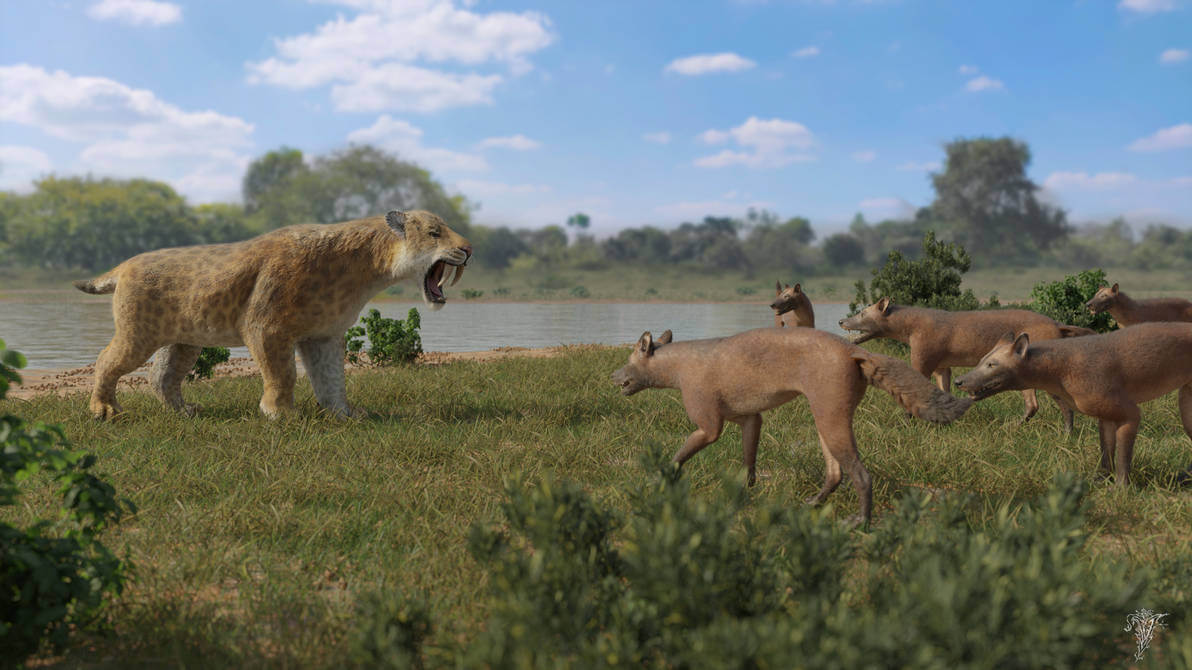
North American mammals proved to be particularly successful colonizers of South America. Carnivores were among the first and most successful migrants. Members of the family Procyonidae (raccoons and relatives) crossed early, followed by mustelids (weasels, otters, and skunks), and eventually large predators, including felids and canids. Species like Smilodon, the famous saber-toothed cat, established populations throughout South America and became apex predators.
The arrival of these sophisticated carnivores had devastating consequences for South America's native predators. The marsupial carnivores and the terror birds both declined precipitously following the invasion. By approximately 2.5 million years ago, the terror birds had suffered significant declines, with the last species disappearing around 1.8 million years ago.
Herbivores from the north proved equally successful. Deer rapidly diversified across South America, occupying browsing niches previously held by native ungulates. Camelids, including ancestors of modern llamas and alpacas, migrated south and adapted to high-altitude environments in the Andes. Proboscideans, including gomphotheres (elephant relatives with four tusks), successfully colonized South America and persisted until the late Pleistocene extinctions approximately 10,000 years ago.
The Southern Response
While northern species flooded into South America, relatively few South American lineages successfully established populations in North America. This asymmetry remains one of the most intriguing aspects of GABI.
The most successful southern migrants were xenarthrans. Ground sloths crossed into North America and diversified, eventually ranging as far north as Alaska. Multiple genera established populations throughout North America, with some species persisting until the terminal Pleistocene extinctions.
Armadillos also successfully colonized North America, with giant species reaching as far north as the present-day United States. Modern nine-banded armadillos (Dasypus novemcinctus) continue to expand their range northward, currently found throughout the southeastern United States.
The opossums (Didelphidae) represent a notable exception—marsupials that successfully colonized North America and continue to thrive there today. The Virginia opossum (Didelphis virginiana) represents the most widespread marsupial in North America, demonstrating that success from southern migrants, while rare, was not impossible.
Ecological Consequences: Winners and Losers
The Great American Biotic Interchange fundamentally restructured the ecosystems of both continents, creating winners and losers in the struggle for survival.
The Extinction of South American Natives
The arrival of northern carnivores and herbivores precipitated a wave of extinctions among South America's endemic fauna. The South American native ungulates suffered catastrophic declines, with most families disappearing during or shortly after the interchange. By the end of the Pleistocene, these last representatives vanished during the terminal Pleistocene extinctions approximately 10,000 years ago.
Marsupial carnivores virtually disappeared following the arrival of placental predators. The ecological replacement was swift and comprehensive, with felids and canids assuming the predatory roles previously held by marsupials. Terror birds could not compete with the sophisticated hunting strategies of pack-hunting canids and the stealth-and-power approach of felids.
Northern Enrichment and Survivors
While South America experienced significant extinctions, North America generally saw an enrichment of its fauna through the addition of southern taxa. Ground sloths diversified into various ecological niches, and armadillos added an entirely new body form and ecological strategy to North American ecosystems.
Not all native South American species succumbed to northern competition. Capybaras (Hydrochoerus hydrochaeris), the world's largest rodents, thrived in semi-aquatic environments where they faced less direct competition. Various monkey species remained successful in arboreal environments. Modern tree sloths, anteaters, and armadillos continue to thrive through adaptation to specialized ecological niches.
Why the Asymmetry?
The asymmetrical outcome of GABI has been attributed to several factors. North American mammals had evolved in continental settings with connections to Eurasia, exposing them to a broader range of competitors and environmental challenges. This "competitive hardening" may have provided them with advantages when encountering South American species that had evolved in isolation.
Northern carnivores possessed more sophisticated hunting strategies, including pack hunting in canids and ambush predation in felids. Northern herbivores may have had more efficient digestive systems or feeding strategies that allowed them to outcompete native South American ungulates for resources.
Climate and Environmental Context
The Great American Biotic Interchange coincided with significant global climate changes that influenced which species successfully migrated and which failed. The Pleistocene Epoch was characterized by repeated glacial and interglacial cycles. These climate oscillations created expanding and contracting habitats, shifting vegetation zones, and varying degrees of environmental stress on species.
The closure of the Central American seaway also had profound effects on ocean circulation patterns. The formation of the isthmus diverted warm Atlantic currents northward, strengthening the Gulf Stream and potentially contributing to Northern Hemisphere glaciation. These climate changes added another layer of complexity to the competitive interactions between northern invaders and southern residents.
The Modern Legacy
The effects of the Great American Biotic Interchange continue to shape the biodiversity and ecological dynamics of the Americas today. The current distribution of species across North and South America reflects the legacy of GABI. The presence of jaguars (Panthera onca) in Central and South America, pumas (Puma concolor) ranging from Canada to Patagonia, and various deer species throughout both continents all result from successful migrations during the interchange.
The Mesoamerican Biological Corridor, stretching from Mexico to Panama, serves as a contemporary reminder of the isthmus's role in connecting species and ecosystems. This network of protected areas facilitates movement and gene flow between populations, echoing the ancient migrations of GABI.
The biological exchange between North and South America did not end with the Pleistocene. Species continue to expand their ranges across the Central American Isthmus, though now at rates influenced by both human activities and natural processes. Nine-banded armadillos continue their northward expansion, reaching new territories in the United States each year.
Human Impact
Early human hunters entering the Americas approximately 15,000 to 20,000 years ago encountered the diverse megafauna resulting from GABI—ground sloths, glyptodonts, gomphotheres, horses, and saber-toothed cats. The terminal Pleistocene extinctions eliminated most large mammals in the Americas around 10,000 years ago, disproportionately affecting GABI participants. Whether climate change, human hunting, or a combination of factors caused these extinctions remains debated.
Conservation Implications
The lessons of the Great American Biotic Interchange are relevant to modern conservation challenges. GABI provides a natural experiment in species invasions at a continental scale, offering insights into what factors make some species successful invaders and others failures.
As contemporary climate change drives species range shifts, understanding historical examples of species movements becomes increasingly important. Modern conservation strategies must account for species movements in response to changing climates. Protecting habitat corridors that allow species to shift their ranges, like the Mesoamerican Biological Corridor, becomes critical. The Central American Isthmus, which facilitated the ancient migrations of GABI, continues to serve as a vital pathway for species responding to environmental change.
Conclusion
The Great American Biotic Interchange stands as one of the most transformative events in the biological history of the Americas. The formation of the Central American Isthmus approximately 3 million years ago created a land bridge that allowed the spectacular migration and mixing of two continental biotas that had evolved in isolation for tens of millions of years.
The interchange was not a simple mixing of equals. Northern species proved far more successful at colonizing South America than southern species were at establishing populations in the north. This asymmetry resulted in the extinction of numerous South American endemic groups, including native ungulates, marsupial carnivores, and terror birds, while enriching North American ecosystems with novel taxa like ground sloths and armadillos.
The ecological and evolutionary consequences of GABI continue to shape the biodiversity of the Americas today. Beyond its intrinsic interest as a remarkable episode in Earth's biological history, GABI provides valuable insights into species invasions, ecosystem dynamics, and the biological consequences of connecting previously isolated biotas.
The story of GABI reminds us that Earth's biodiversity is not static but rather the product of continuous change driven by geological processes, climate fluctuations, and evolutionary innovations. The narrow strip of land connecting North and South America—the Central American Isthmus—served as the stage for one of evolution's grandest dramas, a biological exchange whose effects persist in the ecological communities of the Americas to this day.