
The Amazon Biome: A Tapestry of Interconnected Ecosystems
The Amazon biome extends far beyond the rainforest itself, encompassing 53 distinct ecosystems across 6.7 million sq km (2.6 million sq mi) — from nutrient-rich floodplains and acidic blackwater forests to montane cloud forests and fire-maintained savannas —each shaped by millions of years of geological and climatic evolution.
Beyond the Rainforest: The Amazon's Hidden Diversity
The Amazon biome extends far beyond the iconic rainforest, encompassing a spectacular mosaic of 53 distinct ecosystems across 6.7 million sq km (2.6 million sq mi). This continental-scale biome represents the world's largest tropical biome complex, where dense rainforests give way to seasonal savannas, montane cloud forests, and vast wetlands, each supporting specialized communities of plants and animals found nowhere else on Earth.
As the ecological heart of Amazônia, the biome's remarkable diversity stems from millions of years of geological and climatic evolution, creating a patchwork of environments that ranges from nutrient-rich floodplains to ancient mountaintops, from acidic blackwater swamps to fire-maintained grasslands. This ecological tapestry functions as an integrated system where the health of each component ecosystem influences the stability and resilience of the entire biome.
Continental Reach
The Amazon biome stretches from the eastern slopes of the Andes Mountains to the Atlantic Ocean, and from the Guiana Highlands in the north to the Brazilian Highlands in the south. Unlike political boundaries, the biome's limits are defined by climatic and ecological gradients, creating a naturally integrated system that spans nine countries but functions as a single, interconnected entity.
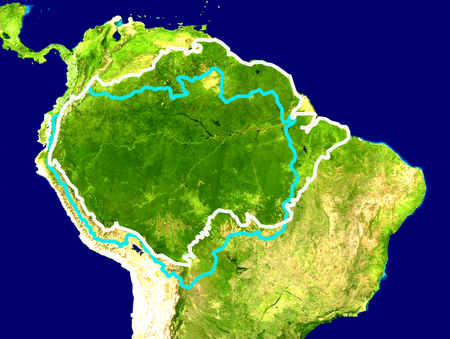
Outline map depicting the extent of the Amazon biome (white outline) and Amazon Basin (blue outline).
The biome's 53 ecosystems fall into five major categories. Forest ecosystems, comprising 34 types and roughly 78% of the biome's total area, include dense rainforest, seasonal forests, cloud forests, and flooded forests. Savanna ecosystems, five types covering 12.75% of the biome, range from tree-dotted grasslands to dense woodland savannas. Floodplain ecosystems, another five types accounting for 5.83%, encompass seasonal and permanent wetlands, river beaches, and aquatic vegetation. Andean ecosystems, six types making up 1.5% of the biome, include montane forests, cloud forests, and high-altitude grasslands. And tropical steppe ecosystems, the smallest category at two types and 1.89% of the total, consist of dry forests and scrublands confined to rain shadow areas.
Terra Firme Forests: The Upland Foundation
Terra firme forests cover approximately 60% of the biome, growing on well-drained upland soils that never flood. These forests reach their greatest structural complexity and species diversity, with canopies 35-45 m (115-148 ft) high, punctuated by emergent trees exceeding 60 m (197 ft). Characteristic species include the Brazil nut tree (Bertholletia excelsa), mahogany (Swietenia macrophylla), and diverse palm species, including açaí (Euterpe oleracea). Plants here have evolved extreme efficiency in nutrient cycling, with surface root mats and mycorrhizal networks capturing nutrients from decomposing litter before tropical rains can leach them away.
Várzea: The Fertile Floodplains
Várzea forests occupy seasonally flooded areas along whitewater rivers, covering 150,000 sq km (58,000 sq mi). These nutrient-rich floodplains support some of the biome's most productive ecosystems, with annual flooding depositing fertile sediments eroded from the Andes. Trees like Macrolobium acaciifolium develop buttressed roots and can survive 6-8 months of flooding, and many species produce floating seeds or fruits that disperse during flood seasons. Fish such as the tambaqui (Colossoma macropomum) feed on fruits in the flooded forest, while river turtles (Podocnemis spp.) nest on seasonal beaches exposed during low water.
Igapó: The Blackwater Forests
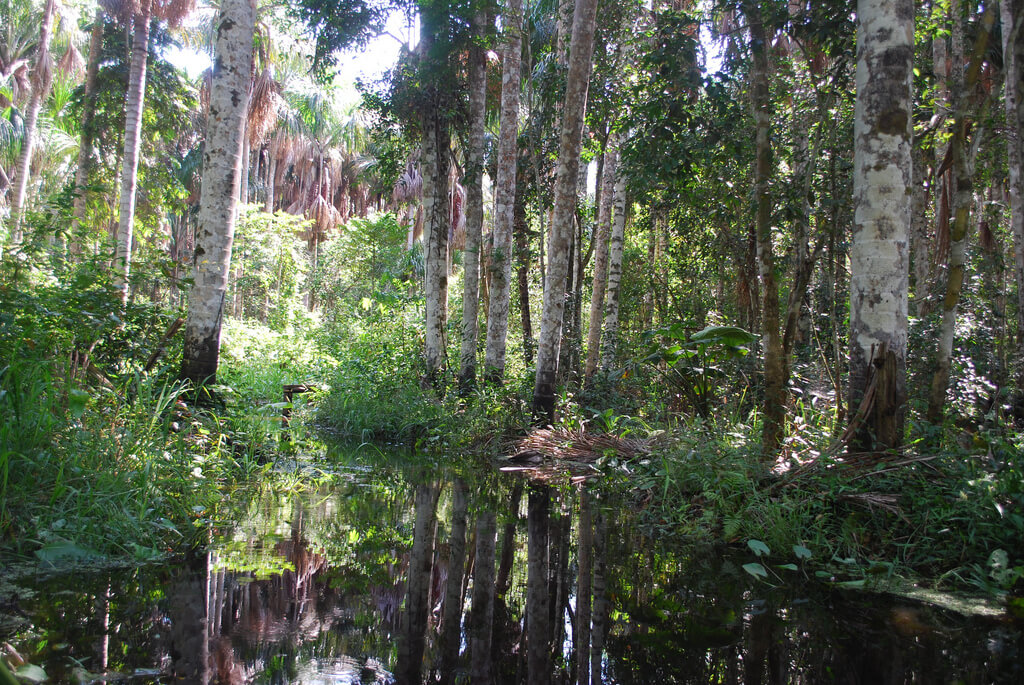
Igapó forests grow along blackwater rivers, flooding with nutrient-poor, acidic water stained dark by dissolved organic compounds. These forests show remarkable adaptations to extreme nutrient limitation and acidic conditions, supporting lower overall diversity than várzea but unusually high endemism, with specialized plant communities adapted to these harsh chemical conditions. Many igapó plants produce high concentrations of phenolic compounds, which contribute to the water's dark color and create unique chemical environments found nowhere else in the biome.
Cerrado Transitions: The Savanna Interface
Where the biome meets Brazil's Cerrado savanna, transitional ecosystems create biodiversity hotspots. These gallery forests, woodland savannas, and grasslands support species from both biomes, plus specialized edge species found only in the transition zone itself. Regular fires maintain open savannas and prevent forest encroachment, and many plants here show clear fire adaptations, including thick bark, underground storage organs, and rapid post-fire sprouting. These transition zones often harbor endemic species and serve as corridors for wildlife movement between the two major biomes they connect.
Montane Ecosystems: Vertical Diversity
Between 1,500-3,500 m (4,920-11,480 ft) elevation on the eastern Andean slopes, persistent cloud cover creates unique montane ecosystems with extraordinary endemism. These cloud forests intercept moisture directly from clouds, creating localized water sources that feed lowland rivers, and high-elevation isolation has produced numerous endemic species, including tree ferns, bromeliads, and orchids found only in specific mountain valleys. Cloud forests also play a critical role in regional water cycles, capturing atmospheric moisture that eventually flows into lowland river systems.
Above the tree line, grass-dominated páramo ecosystems extend up to 4,500 m (14,760 ft). These high-altitude grasslands store vast amounts of carbon in their soils and regulate water flow to the lowland areas far below them.
Aquatic Ecosystems: The Liquid Threads
Amazonian rivers fall into three distinct types based on their water chemistry and origin. Whitewater rivers, originating in the Andes, carry high sediment loads and nutrients, supporting the productive várzea ecosystems described above. Blackwater rivers, draining ancient, weathered soils, are acidic and nutrient-poor but support the specialized endemic communities of the igapó. Clearwater rivers, flowing from the Brazilian and Guiana shields, have intermediate characteristics and support their own distinct fish communities.
During flood seasons, vast areas of the floodplain become temporary lakes supporting unique aquatic communities. These seasonal wetlands serve as nurseries for fish species and feeding grounds for millions of waterfowl each year.
Biodiversity Patterns and Endemism
The biome's biodiversity operates at multiple scales. Alpha diversity, the local species richness within individual ecosystems, often exceeds 300 tree species per hectare in terra firme forests alone. Beta diversity, the turnover of species between different sites, creates the biome's extraordinary regional diversity, with different river valleys often harboring unique endemic species found nowhere else. And gamma diversity, the biome's total species pool across all these scales combined, may exceed one million species once invertebrates are included.
Biogeographers have identified several centers of endemism within the biome. The Guiana Shield's ancient geological stability has allowed the evolution of unique plant and animal communities that are found nowhere else on the continent. The western Amazon, with its high habitat diversity and proximity to the Andes, supports numerous additional endemic species. And the Inambari Center, between the Ucayali and Tapajós rivers, shows exceptionally high bird and butterfly endemism relative to the surrounding forest.
Ecological Processes at the Biome Scale
The biome functions as an integrated nutrient cycling system. Rivers transport nutrients from Andean sources down to lowland forests, while animal movements redistribute nutrients across ecosystem boundaries; seed dispersal by large mammals and birds connects forest patches separated by hundreds of kilometers, linking ecosystems that might otherwise function in isolation.
The biome also generates much of its own weather through massive evapotranspiration. Forest areas release 4-8 liters (1-2 gal) of water vapor per sq meter daily, creating atmospheric rivers that transport moisture across the continent and, by some estimates, influence rainfall patterns as far away as Argentina and North America.
Different ecosystems within the biome store carbon in markedly different amounts and forms. Terra firme forests hold 300-400 tons of carbon per hectare, mostly in above-ground biomass; várzea forests hold somewhat less, 200-300 tons per hectare, cycling more rapidly due to periodic flooding; savannas store just 50-150 tons per hectare, with most of that carbon held in soils and roots rather than standing biomass; and wetlands, despite their modest visual footprint, can store over 500 tons per hectare in their organic soils, making them disproportionately important carbon sinks relative to their area.
Human Interactions Across Ecosystems
Different ethnic groups across the biome have developed specialized knowledge for managing specific ecosystems. Riverine communities along the major rivers practice flood-pulse agriculture, planting crops directly on the fertile beaches exposed during low-water periods. Forest-dwelling groups, including the Kayapó, create and maintain forest islands within savanna areas, increasing regional biodiversity and resource availability in a practice closely related to the terra preta, or Amazonian dark earth, soils described in our Amazon Rainforest article. Andean communities at the biome's western edge practice complex altitudinal zonation, managing crops and wild resources across steep elevation gradients within a single day's walk.
Conservation Across a Mosaic of Ecosystems
Each ecosystem type within the biome faces distinct threats. Forests remain primarily threatened by deforestation for cattle ranching and soy cultivation; savannas by conversion to industrial agriculture, which eliminates native grasslands and their specialized fauna outright; wetlands by dam construction, which alters the natural flood cycles that fish reproduction and nutrient distribution depend on; and montane areas by mining and infrastructure development that threaten water sources for entire downstream watersheds.
Because the biome's ecosystems are so tightly interconnected, effective conservation increasingly requires landscape-scale rather than site-by-site thinking: connecting protected forest areas through riparian corridors and secondary growth to maintain wildlife movement, protecting entire watersheds rather than isolated wetlands to preserve the hydrological processes that sustain multiple ecosystem types at once, and safeguarding elevation gradients so that species have somewhere to migrate as the climate changes. Satellite monitoring, genetic barcoding, and atmospheric sampling have all become increasingly important tools for tracking how these ecosystems change and interact. Mounting evidence suggests forest-savanna boundaries may shift significantly as precipitation patterns change, that mycorrhizal networks may connect plants across ecosystem boundaries at a scale far larger than previously understood, and that large mammals like tapirs (Tapirus terrestris) actively shape ecosystem composition through their feeding and movement patterns in ways that traditional ecosystem models have only recently begun to account for.
Conclusion: The Living Mosaic
The Amazon biome represents far more than the sum of its parts. This continental-scale mosaic of interconnected ecosystems functions as a single, integrated system that influences weather patterns across multiple continents and harbors a significant portion of Earth's biodiversity.
Understanding the biome's complexity, from cloud forests that capture moisture on Andean peaks to seasonal wetlands that nurture fish populations hundreds of kilometers downstream, reveals why protecting this system requires thinking beyond individual ecosystems to embrace landscape-scale conservation approaches. As climate change and human pressures continue to challenge these ecosystems, their interconnected nature becomes both vulnerability and strength: the biome's diversity provides real resilience against environmental change, but protecting it also demands the kind of unprecedented international cooperation and holistic management that recognizes the Amazon biome as one of Earth's most precious and irreplaceable treasures.