
Salar del Hombre Muerto and Salinas Grandes: Argentina's Divided Lithium Frontier
In the high desert of northwestern Argentina, two great salt flats sit atop some of the world's richest lithium reserves. Salar del Hombre Muerto and Salinas Grandes have followed sharply divergent paths: one is now defined by two decades of active extraction and its disputed consequences, the other by sustained Indigenous resistance that has so far kept mining at bay.
Salar del Hombre Muerto and Salinas Grandes: Argentina's Divided Lithium Frontier
High on the Puna, the arid Andean plateau that stretches across northwestern Argentina at elevations above 3,000 m (9,840 ft), two vast salt flats hold a disproportionate share of the world's lithium wealth. Salar del Hombre Muerto, straddling the border of Catamarca and Salta provinces, and Salinas Grandes, straddling Jujuy and Salta further north, together form the Argentine leg of the so-called lithium triangle—the arc of salt flats spanning Argentina, Bolivia, and Chile that holds more than half of the world's known lithium reserves. Yet the two salars have followed sharply different paths over the past three decades. One has been mined continuously since the late 1990s and is now grappling with the disputed consequences of that extraction. The other remains, for now, largely unmined, held off by one of the most sustained and successful Indigenous resistance campaigns anywhere in the lithium triangle.
Formation and Geography
Both salars are endorheic basins—landlocked depressions with no outlet to the sea—formed as ancient lakes evaporated over millions of years within the tectonically active Puna-Altiplano plateau, the same high-elevation zone that hosts Bolivia's Salar de Uyuni and Chile's Salar de Atacama, protected within Los Flamencos National Reserve. Beneath the dry salt crust of each lies a reservoir of lithium-rich brine, concentrated over geological time as mineral-laden runoff from the surrounding volcanic peaks pooled and evaporated in these closed basins with no drainage to flush the dissolved minerals away.
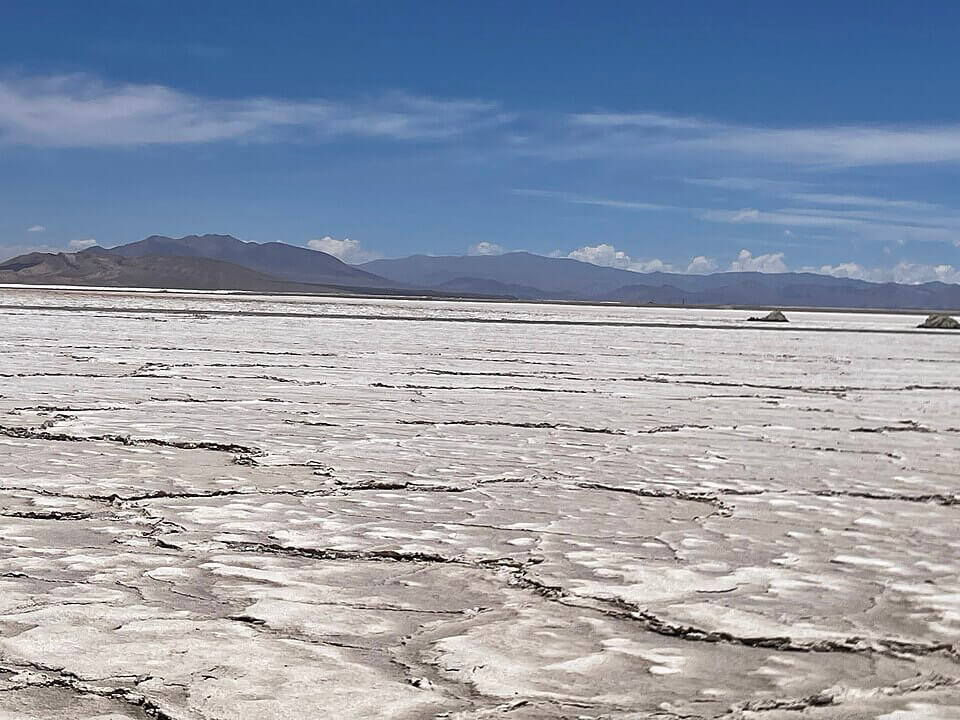
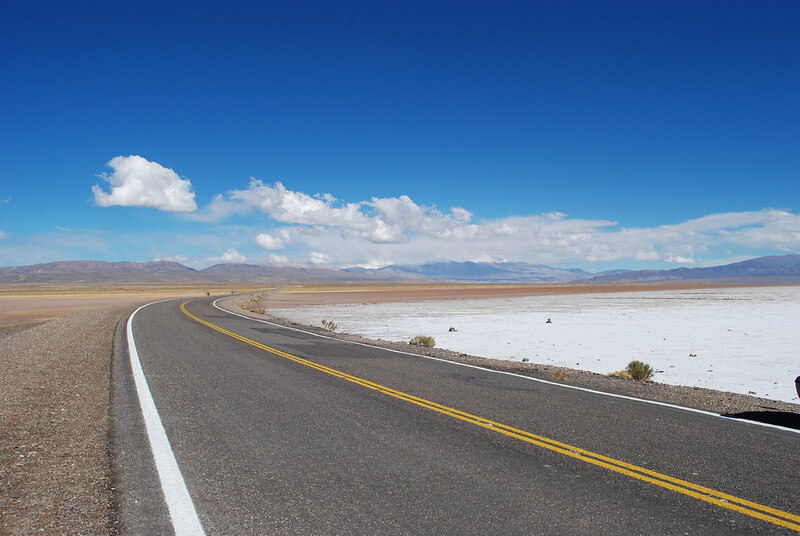
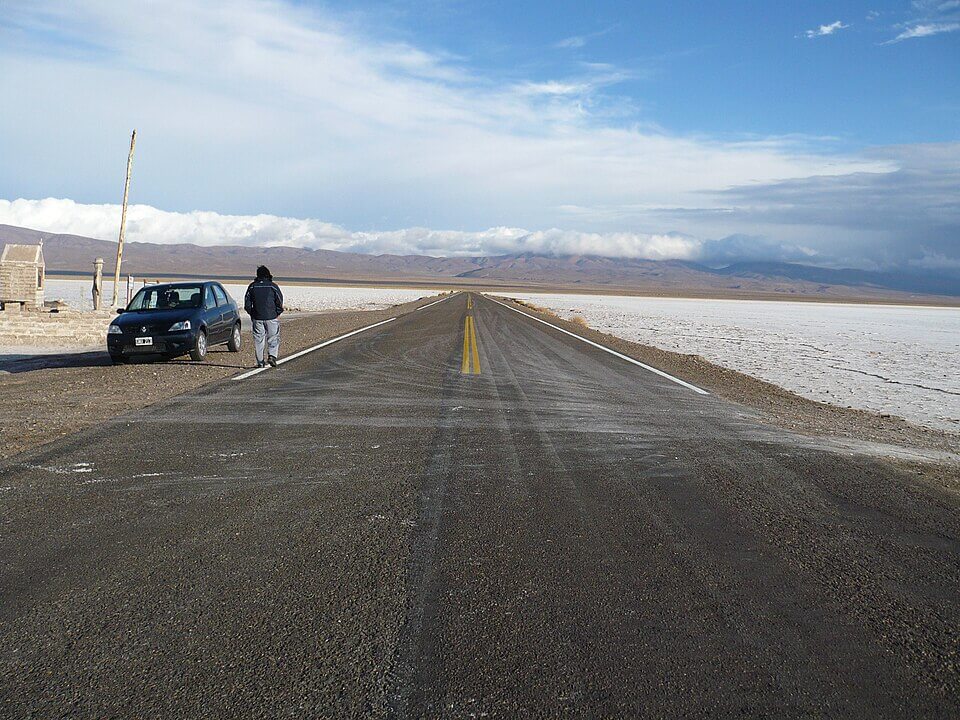
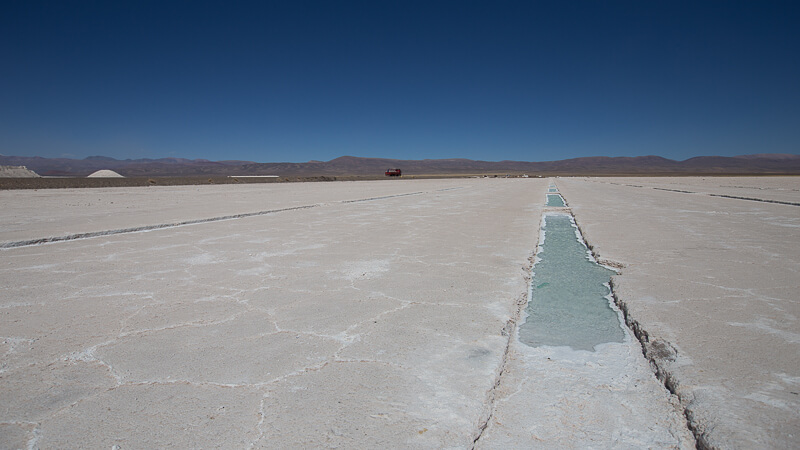
Salar del Hombre Muerto covers approximately 600 sq km (232 sq mi) at an elevation of roughly 4,000 m (13,123 ft), its geology closely resembling that of the Salar de Atacama across the Chilean border. Salinas Grandes is smaller, at approximately 212 sq km (82 sq mi), and sits slightly lower at around 3,450 m (11,320 ft); it forms part of a larger endorheic basin shared with the nearby Laguna de Guayatayoc, and is well known for the near-blinding whiteness of its salt crust, which stretches unbroken for stretches long enough that Argentina's National Route 52 crosses directly over it.
Salar del Hombre Muerto: Two Decades of Extraction
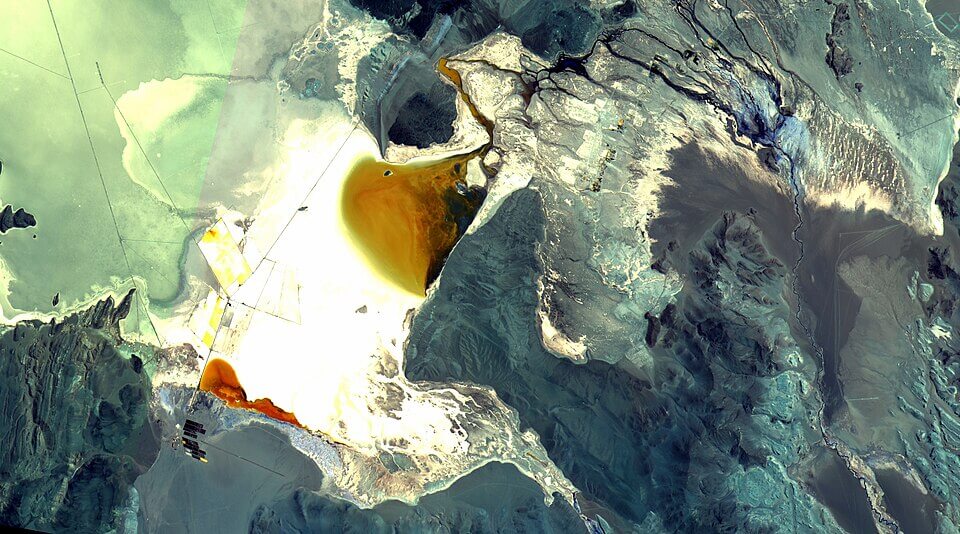
Lithium extraction at Salar del Hombre Muerto began in earnest in the late 1990s, when the American chemical company FMC Corporation—later spun off into the standalone lithium producer Livent—opened the Fenix mine in the salar's western sector following geological surveys conducted between 1990 and 1995. Fenix remains one of the longest continuously operating lithium brine facilities in South America, producing lithium carbonate and lithium chloride for battery manufacturers worldwide, and its long operating history has made Hombre Muerto one of the most closely studied sites in the entire lithium triangle for understanding the long-term effects of brine extraction on a desert ecosystem.
That history has not been without dispute. Communities living near the salar, particularly along the Trapiche River, have accused Livent's operations of contributing to the river running dry. In response, Catamarca's provincial Supreme Court moved to prohibit the granting of further extraction permits in the basin pending a comprehensive study of the accumulated environmental impact of all mining activity carried out there to date. The case illustrates a pattern increasingly common across the lithium triangle: extraction proceeds for years under the terms of the permits available at the time, and only once measurable environmental change becomes apparent do courts and regulators intervene, by which point the underlying hydrological damage, if any, is already difficult to reverse.
Salinas Grandes: A Salt Flat Successfully Defended
Salinas Grandes tells a markedly different story. The salt flat has been worked for far longer than any lithium company has been interested in it: for centuries, Kolla and Atacameño communities of the surrounding Salinas Grandes and Laguna de Guayatayoc basin extracted salt by hand for their own use and for trade along Andean caravan routes that once carried salt as far as the lowlands of the Chaco and the Argentine pampas, a tradition some communities continue in smaller form today. That long-standing relationship with the salar became the foundation for one of the lithium triangle's most effective resistance movements once mining companies began seeking exploration rights in the area in the late 2000s.
In 2010, a coalition of 33 Indigenous communities from the Salinas Grandes and Laguna de Guayatayoc basin organized roadblocks, filed administrative and judicial challenges, and demanded free, prior, and informed consent before any exploration could proceed, arguing that pumping the ancient brine beneath the salt crust would inevitably draw down the same water table their communities and livestock depend on. That coalition, which has since grown to include communities from a wider area, has succeeded in stalling large-scale lithium development at Salinas Grandes for well over a decade, even as multiple companies, including LSC Lithium, have held exploration concessions covering large sections of the basin. It remains one of the few sites in the entire lithium triangle where organized Indigenous opposition has prevented brine extraction from beginning at all, rather than only contesting its consequences after the fact—a distinction the communities involved have been explicit about, framing their resistance not as opposition to development in the abstract, but as a refusal to become, in the words of one community leader, "the guinea pig of the energy transition."
Life on the Salt: Shared Ecology
Despite their different fates, both salars support similar high-Andean wildlife adapted to extreme aridity, thin air, and intense daily temperature swings. Vicuña (Vicugna vicugna) and guanaco (Lama guanicoe) graze the sparse vegetation at the margins of both basins, while the surrounding wetlands and shallow lagoons, where present, draw Andean flamingos (Phoenicoparrus andinus) and James's flamingos (Phoenicoparrus jamesi) to feed on the brine shrimp and algae that thrive in the mineral-rich water. This same overlap between flamingo habitat and lithium-bearing brine is precisely what has made the wider lithium triangle, from these two Argentine salars to Chile's Los Flamencos reserve and Bolivia's Uyuni basin, one of the starkest points of tension between renewable-energy supply chains and high-Andean conservation anywhere on Earth.
Conclusion
Salar del Hombre Muerto and Salinas Grandes sit less than 300 km (186 mi) apart, share the same geological origins, and hold reserves of the same increasingly strategic mineral—yet nearly thirty years after lithium extraction first began in the region, they represent two entirely different outcomes. One has been mined continuously for a generation and is now confronting, through provincial courts, the environmental costs of that extraction. The other remains substantially undeveloped, held in reserve less by geology or policy than by the sustained determination of the communities who have lived on its shores for centuries. As global demand for lithium continues to climb, the divergent paths of these two salars offer a rare, close-up comparison of what extraction looks like when it proceeds largely unchecked, and what becomes possible when the communities most directly affected are able to make their opposition heard before the first well is drilled.