
Valdivian Coastal Reserve: A Forest Rescued at Auction
The Valdivian Coastal Reserve protects about 50,000 hectares of Chile's coastal temperate rainforest, bought at a bankruptcy auction in 2003 to stop its conversion to eucalyptus plantations and managed since then by The Nature Conservancy.
The Valdivian Coastal Reserve: A Forest Bought at Bankruptcy Auction, and What Came After
The Valdivian Coastal Reserve lies in the Cordillera Pelada of Chile's Los Ríos Region, in the communes of Corral and La Unión, about 40 km southwest of Valdivia along the road linking Corral with the village of Chaihuín, where its headquarters stands. It covers roughly 50,000 hectares (about 123,500 acres) and 36 km (22 mi) of Pacific coastline. It is a private reserve owned and managed by The Nature Conservancy (TNC), which Wikipedia describes as the largest protected area in the Chilean Coast Range. Together with the adjoining Alerce Costero National Park, created in part from land the reserve donated, it protects more than 60,000 hectares (148,000 acres) of the Valdivian temperate forests.
A Forest Rescued at Auction
Until the early 2000s, the property was an industrial forestry holding, the subject of controversy in the 1990s for converting native forest to eucalyptus plantations grown for paper pulp, an activity the Chilean state encouraged by subsidizing 75% of the cost of profitable exotic-species plantations until 2012. A planned coastal highway also threatened the native forest. In 2003, a lender pushed the forestry company, Bosques S.A., into bankruptcy, and the land went to public auction. TNC, working with WWF, bought it in late 2003 for about US$7.5 million, and the reserve opened on March 22, 2005, covering nearly 60,000 hectares (148,000 acres). TNC says the purchase ended the immediate threat of deforestation and of the highway being built through the property.
Sharing the Land: Reserve and National Park
TNC later donated more than 10,000 hectares (24,700 acres) of the property's native forest to the Chilean state to help create Alerce Costero National Park, under what it describes as Chile's first private-public cooperation agreement for a joint conservation management plan. The park now protects the Gran Abuelo and the old-growth alerce stands covered in our dedicated article, while the reserve, at about 50,000 hectares (123,500 acres), remains privately managed. The two areas adjoin one another and together form one of the largest protected blocks of coastal rainforest in southern Chile.
Restoring a Plantation Landscape
About 83% of the reserve is Valdivian temperate rainforest, but roughly 8% was cleared, burned, and planted with eucalyptus, an area variously reported as between 3,400 and 3,600 hectares (8,400 and 8,900 acres). Restoration began in 2006, with eucalyptus harvested and the sites replanted with native trees such as coigüe (Nothofagus dombeyi) or left to regenerate naturally. In 2013, BHP, in an alliance with Conservation International and TNC, committed US$8.9 million for 2013 to 2015 to cover the original acquisition costs, near-term management, and reforestation, with a further US$11.5 million planned for a long-term endowment and a conservation easement to guarantee conservation as the reserve's future use. BHP described the work as Chile's largest native forest restoration, with some 3,500 hectares (8,600 acres) of eucalyptus removed and more than 2.5 million native trees planted. A newer community restoration project, supported by the MetLife Foundation, has added a native plant nursery of more than 800 square meters (8,600 square feet) and silvopastoral restoration areas. TNC says it reinvests earnings from forestry or carbon credits in the reserve, which has been developed as a forest carbon project aimed at avoiding planned deforestation.
What the Reserve Protects
Near the coast, the reserve is dominated by dense olivillo (Aextoxicon punctatum) forest, while the alerce (Fitzroya cupressoides) grows at higher elevations. TNC organizes its monitoring around nine conservation targets: alerce forest, evergreen forest, coastal olivillo forest, freshwater ecosystems and estuaries, rocky coast, dunes and sandy beaches, three flagship mammals (Darwin's fox, the güiña, and the pudú), forest amphibians, and cultural heritage. The reserve protects more than 3,000 hectares (7,400 acres) of alerce forest, and in 2023 researchers from the FORECOS foundation and the Universidad Austral de Chile, working with the reserve's rangers, dated two living alerces at 2,208 and 2,051 years old, making them the second- and third-oldest living trees of the Coastal Range, behind only the Gran Abuelo.
Darwin's Fox and Other Wildlife
More than two decades of camera trapping have shown the reserve to be, in the words of one researcher, a box of surprises. In 2014, the cameras confirmed Darwin's fox (Lycalopex fulvipes), an Endangered canid long associated with Chiloé, on the mainland coast, adding the Valdivian Coast Range to its known distribution. The reserve is also home to the güiña (Leopardus guigna), the smallest wild cat in the Americas, the pudú (Pudu puda), one of the world's smallest deer, the monito del monte (Dromiciops gliroides), a marsupial often called a living fossil, the Magellanic woodpecker (Campephilus magellanicus), and Darwin's frog (Rhinoderma darwinii). TNC counts at least 58 bird species, and along the coast the reserve shelters South American sea lions (Otaria flavescens), cormorants, and ringed kingfishers (Megaceryle torquata) on the Chaihuín River. A bilingual field guide produced with Fundación Oceanósfera describes 100 plant and animal species.
Dunes, Lagoons, and Rivers
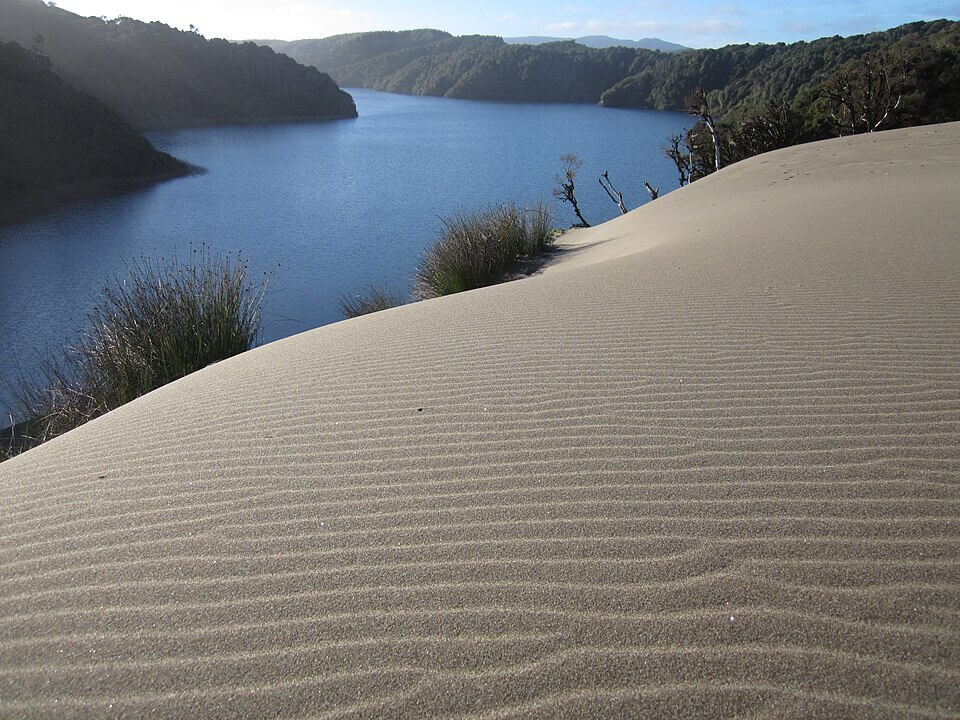
The reserve's coastline includes the roughly 9 km (5.5 mi) Colún Beach, backed by a large dune field with archaeological remains and olivillo forest, and the Twin Lagoons of Colún just inland. The Colún and Chaihuín rivers flow out to the Pacific along the reserve's edge, and the lower Bueno River forms its southern boundary.
People Around the Reserve
The reserve's buffer zone covers about 1,740 sq km (672 sq mi) and, at the 2002 census, held roughly 1,988 people in villages including Chaihuín, Huiro, Cadillal, and Huape. Huiro is a Mapuche-Huilliche community. TNC says it has kept neighbors' access to fishing grounds and to non-timber products such as fruits and roots, supports local enterprises such as the Kutralhue de Huiro women's cooperative and the Chaihuín Farming and Forest Cooperative, and has developed a pilot cooperative management agreement with local fishing associations to recover shellfish and other bottom-dwelling resources. Independent research on the reserve is more mixed. One study of the surrounding communities found local attitudes shifting from an extractive view of the forest in 2003 toward a more sustainable one by 2012, while another asked whether people in the buffer zone have equal access to the development projects that conservation has brought.
Legal Status and the Highway Question
For most of its history, the reserve's protected status was informal, because Chile had no legal framework for private protected areas. Law 21.600, published in September 2023, created the Biodiversity and Protected Areas Service and a national system of protected areas that includes private ones under state supervision, providing the missing framework. The highway question is less settled: TNC says its purchase prevented the coastal road from being built across the property, but plans for the Southern Coastal Highway along the Los Ríos and Los Lagos coast have continued to be cited as a threat to the Colún and Bueno River sectors.
Visiting the Reserve
The reserve is open to the public, with demonstration trails and beaches that draw most visitors in summer, and local guides from Chaihuín lead excursions to the alerce forests and Colún Beach.
Conclusion
The Valdivian Coastal Reserve is one of Chile's most closely watched experiments in private conservation: land saved from conversion at a bankruptcy auction, then restored, shared with the state, and managed alongside the people who live around it. Whether its model proves durable will depend on settled legal protection, on keeping the coastal highway off its dunes and rivers, and on the benefits it brings to neighboring communities.