
The Gran Chaco: Exploring the Wild Heart of South America
The Gran Chaco is South America's second-largest forested biome after the Amazon, a vast semi-arid lowland spanning Argentina, Paraguay, Bolivia, and Brazil — home to a peccary once known only from fossils, a controversial tannin-extraction industry that reshaped the landscape a century ago, and among the last peoples anywhere outside the Amazon living in voluntary isolation.


The Gran Chaco: A Lost Animal, a Vanishing Forest, and the Last Uncontacted Peoples Outside the Amazon
Stretching across the heart of south-central South America, the Gran Chaco is the continent's second-largest forested biome after the Amazon, a vast semi-arid lowland covering over 1 million sq km (386,000 sq mi) across Argentina, Paraguay, Bolivia, and a small part of Brazil. Bounded to the west by the towering Andes and framed by the Paraguay and Paraná rivers to its east, the Gran Chaco divides broadly into the arid Dry Chaco to the west and the wetter Humid Chaco to the east, each covered in greater ecological depth in its own dedicated article. But the Gran Chaco is more than the sum of its two ecoregions: it is a landscape defined by a peccary once presumed extinct for tens of thousands of years, by a brutal early-20th-century industry that stripped its forests for a single chemical compound, and by Indigenous communities that include some of the last peoples anywhere outside the Amazon still living in voluntary isolation from the outside world.
Three Subregions, One Vast Lowland
Geographers typically divide the Gran Chaco into three broad subregions. The Chaco Boreal, in the north, spans southeastern Bolivia and the northern Paraguayan Chaco, the driest and least populated portion of the entire region. The Chaco Central lies between the Pilcomayo River to the north and the Bermejo River to the south, a transitional zone blending grassland, quebracho woodland, and features of both its drier northern and wetter eastern neighbors. And the Chaco Austral, in the south, extends across northern Argentina toward the Paraná and Salado river systems, where the landscape gradually softens into the pampas beyond.
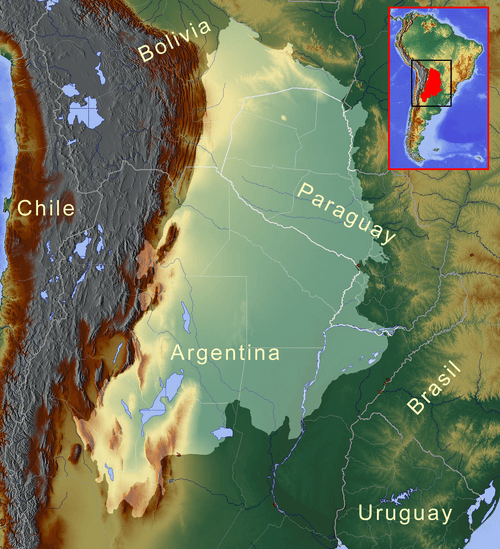
Map of the Gran Chaco.
Quebracho: The Tree That Broke Axes, and an Industry That Broke a Landscape
No single resource shaped the Gran Chaco's modern history more than quebracho, whose Spanish name, "quiebra hacha" or "axe-breaker," describes wood so dense it can sink in water and blunt a steel blade. Red quebracho (Schinopsis balansae and Schinopsis lorentzii) contains an exceptionally high concentration of tannin, the compound used for centuries to cure leather. Beginning in the late 19th century, foreign companies, most notably the Argentine-registered but British- and French-financed La Forestal, built an industrial empire across the Chaco Austral and Humid Chaco to extract it. At its peak in the 1920s, La Forestal operated dozens of company towns, its own railways, ports, and even its own currency, employing tens of thousands of workers to fell quebracho forests across an area larger than some European countries and process the wood into tannin extract for export to tanneries worldwide. The industry collapsed by the mid-20th century as synthetic tanning agents replaced natural tannin and the most accessible quebracho stands were exhausted, leaving behind abandoned company towns and a landscape of degraded forest that, in places, has never fully recovered. Quebracho remains one of the two dominant hardwoods across both the Dry and Humid Chaco today, but the scars of the tannin era remain visible in the region's land-use patterns more than a century later.
The Peccary That Came Back From Extinction
Few stories capture the Gran Chaco's capacity to surprise science quite like that of the Chacoan peccary (Catagonus wagneri). In 1930, Argentine paleontologist Carlos Rusconi described the species from Pleistocene fossils and concluded it had gone extinct many thousands of years ago. For four decades, that verdict stood unchallenged among Western scientists. Then, around 1971, researchers working in Argentina's Salta province and Paraguay's central Chaco realized that a living, breathing population of the same species was walking through the thorn forest in front of them, a discovery formally published in the journal Science in 1975 under the fitting title "Catagonus, an 'extinct' peccary, alive in Paraguay." Local Indigenous communities, who had always known the animal by the name tagua, had never doubted its existence; it was Western science that needed catching up. Today, fewer than 3,000 Chacoan peccaries are thought to survive in the wild, restricted almost entirely to the driest, least disturbed portions of the Dry Chaco, making it one of the most endangered large mammals in South America and a powerful symbol of how much the Gran Chaco still has left to reveal.
The Ayoreo: Among the Last Peoples Living Beyond Contact
The Gran Chaco is home to numerous Indigenous peoples, including the Wichí, Toba (Qom), Chorote, and Nivaclé, whose communities span the border regions of Argentina, Paraguay, and Bolivia and who maintain distinct languages and deep traditional knowledge of the Chaco's plants and animals. Among them, the Ayoreo of the northern Paraguayan Chaco hold a particular and urgent significance: several Ayoreo groups remain uncontacted or in voluntary isolation, making them, alongside certain Amazonian peoples, among the very last populations anywhere in the Americas living entirely outside contact with the wider world. Their continued survival depends directly on the intact forest of the northern Dry Chaco, placing them squarely in the path of the agricultural clearing described below, and human rights and Indigenous advocacy organizations have repeatedly warned that continued deforestation in this specific area poses a direct existential threat to isolated Ayoreo groups' ability to remain uncontacted, and indeed to survive at all.
A Vanishing Forest
The Gran Chaco is disappearing at one of the fastest rates of any major forest biome on Earth; in several recent years, satellite monitoring has recorded more forest loss within the Chaco than within the Brazilian Amazon, despite the Amazon's far greater size, a consequence of just how rapidly cattle ranching and, especially in the Argentine Chaco, soybean cultivation have expanded across the region since the 1990s. Bolivia's Kaa-Iya del Gran Chaco National Park, at roughly 3.4 million hectares (8.4 million acres), one of the largest protected areas in South America, was established in 1995 specifically to protect Chacoan peccary habitat, co-managed in partnership with the Indigenous Izoceño-Guaraní communities who share the land. In Argentina, El Impenetrable National Park, established in 2014 in Chaco province, protects a similarly vital stronghold for the peccary and the giant armadillo within the Dry Chaco's namesake "impenetrable" thorn forest, while Paraguay's Defensores del Chaco National Park protects further significant tracts. Collectively, however, protected areas across the whole Gran Chaco still fall well short of the scale needed to secure the biome's long-term future, particularly in the Argentine and Paraguayan portions where private land clearing continues largely unchecked.
Conclusion
The Gran Chaco resists easy categorization: neither as celebrated as the Amazon nor as visually dramatic as the Andes, it is nonetheless one of South America's great wild places, a biome that hid an entire species from science for forty years, absorbed and then discarded an entire extractive industry, and still shelters some of the last peoples on the continent living beyond the reach of the modern world. Its future, and that of the peccary, the Ayoreo, and the millions of hectares of thorn forest and savanna in between, depends on whether Argentina, Paraguay, Bolivia, and Brazil can slow a rate of deforestation that, for now, shows few signs of stopping.